2 Ocak 2013 Çarşamba

Bryant Terry's Inspired Southern Food (Vegan)

To contact us Click HERE


So, Paula Deen decides to make lighter Southern food and it gets headlines? It's a campaign year, and I am sick of the mud-slinging, so I will just say this: I think the wrong person has been getting the headlines all this time. When it comes to Southern food, real Southern food that has evolved — as any cuisine should — my vote is for Bryant Terry, including his book, The Inspired Vegan.

Yes, vegan. And Southern food without bacon and lard. Terry's recipes use many of the classic ingredients one associates with good Southern cooking; black-eyed peas, greens, sweet potatoes, grits, johnny cakes, sweet tea, molasses. And, he definitely doesn't use factory-farmed pork or Velveeta, which is not on any seasonal, heritage ingredient list I can fathom, Southern or not. The beauty of Terry's take on Southern ingredients is that he's re-thought them, added his life influences, often Asian, and continues to create. Food, like everything else, must evolve.

Terry's food is healthy. This commitment to good, healthy food is not just in his cooking, he lives it. Terry has worked for food access and food justice as well as nutrition education and empowerment throughout the span of his career. This is not a new brand image he's acquired for marketing purposes.

Vegan or not, and I am not a vegan, his recipes are creative, and, as the title suggests, inspired. The recipe for Savory Grits with Sauteed Broad Beans, Roasted Fennel, and Thyme is the sole reason my 7-year-old now requests "Fennel!" as a favorite vegetable when we shop.

This fall, I am looking forward to trying Sweet Potato-Cornmeal Drop Biscuits with Maple Syrup. The fresh shell peas at the market right now will be great in Black-eyed Peas in Garlic Ginger Braised Mustard Greens. Terry's Pickled Red Onions are a staple condiment in our fridge for months now.

Get past the "vegan" thing if you are not vegan. When I am run dry on ideas for making vegetables delicious, I turn to vegan cookbooks for inspiration. Not the ones that try to make non-meat versions of a burger or hot dog, but the ones like Terry's that embrace the flavors and richness that vegetables and grains can bring. The title is so aptly named. This is Inspired cooking. And Terry, as a chef who uses his creativity to help and inspire others, and to bring about food justice and healthy choices for all is my kind of inspiration, too.

It's Bigger Than Just School Lunch

To contact us Click HERE

As many blog posts as I have written bemoaning school lunches and nutrition for kids, it's refreshing to share good news. Here's an updated menu with the proposed USDA changes for better nutrition for school meals. It's much improved and I was even surprised to see jicama on the ingredients list.
What I like most about it is that it is a bit realistic. It's healthier swaps for things kids have been eating. What I would call "transitional foods." There's a chance kids will actually eat part of these lunches. Much of the rationale used to block school food changes hinged on precisely that: kids won't eat healthy foods. There is more waste. It won't work. And, frankly, they are right. If kids won't eat these items at home, how can we expect them to at school?
It's like a chicken and egg thing. Or a chicken nugget and egg mcmuffin thing. Do kids eat poorly because they get junk food in schools every day, or do kids eat junk food every day so they will only eat junk food in schools?
I've read with envy all the amenities and fresh food that Alice Water's and Co. have implemented in Berkeley schools along with their Edible Schoolyard program. I think about that program, even as I am applauding these hard-won changes. But,read
 this article in Grist about just how well the kids in Berkeley are eating and what they are not eating. Do they eat a better diet and non-processed foods than other kids? Yes. But, even with all the advantages, frankly the kids still aren't eating as well as they could.

We're winning in our schools. Which is incredibly important for kids whose best meals and main nutrition for the week come from our school lunch program. Let's not stop here. 
Let's keep fixing school lunches.Let's fix lunch at home. Let's help others get access to affordable, healthy foods.Let's make healthier choices in quick serve restaurants. Let's tackle junk food marketing to kids.Let's tackle our whole food system that's designed around commodity crops for animal feed and processed foods.
Let's tackle our own kid's eating habits at home.

A bit of history for perspective:


The first school lunch programs were created by teachers and moms. They often included things like a garden on site and even a cow for fresh milk.

The first school lunch legislation was passed in 1946. The program was not designed as a way to help feed hungry kids alone. It was also established to use surplus agricultural commodities which in turn kept food prices from crashing. The program was funded with $10 million per year in 1946 dollars (114.6 million today) to feed 6.7 million children. Today's budget is $11 billion annually to feed 31 million kids daily.

What are "surplus agricultural commodities?" Commodities may not sound much like food, but historically this meant the basic items produced from a farm; corn, wheat, soy, rice, meat, milk, eggs, fruit and vegetables. Not so much now, but we'll get to that in a later lesson.

In many ways, the 1946 legislation was well-intentioned if not fairly administrated. Okay, it sounded good at least.

Here's a few other quotes from the 1946 legislation that might make us all yearn for the good old days, or at least the old days of good lunch as it was promised:
  • "The need for a permanent legislative basis for a school lunch program, rather than operating it on a year-to-year basis, or one dependent solely on agricultural surpluses that for a child may be nutritionally unbalanced or nutritionally unattractive, has now become apparent."
  • "It is hereby declared to be the policy of Congress, as a measure of national security, to safeguard the health and well-being of the Nation's children and to encourage the domestic consumption of nutritious agricultural commodities and other food ..."
  • "The educational features of a properly chosen diet served at school should not be under-emphasized. Not only is the child taught what a good diet consists of, but his parents and family likewise are indirectly instructed."
While it may seem like some of our lunch items around today have enough preservatives to have endured since 1946, the lunch program then contained a lot fewer processed foods. It was 1946 after all. Here are the 1946 recommendations for a typical meal per child:
Milk, whole, 1/2 pint Protein-rich food consisting of any of the following or a combination thereof:
  • 2 oz. Fresh or processed meat, poultry meat, cheese, cooked or canned fish
  • Dry peas or beans or soy beans, cooked, ½ cup
  • Peanut Butter, 4 tbsp.
  • Eggs, 1
Raw, cooked, or canned vegetables or fruits, or both, ¾ cupBread, muffins or hot bread made of whole grain cereal or enriched flour, 1 portion
So, at least 66 years ago, folks knew that our country's future was linked to healthy children. That not all agricultural commodities are healthy foods. And that the meal provided should be exemplary of what families should eat at home. The meal was also based on whole foods; milk, protein, vegetables, fruits and whole grains.

1 Ocak 2013 Salı

Unwrap Hope: Winter Wonder Cloches

To contact us Click HERE

cloche 057-002

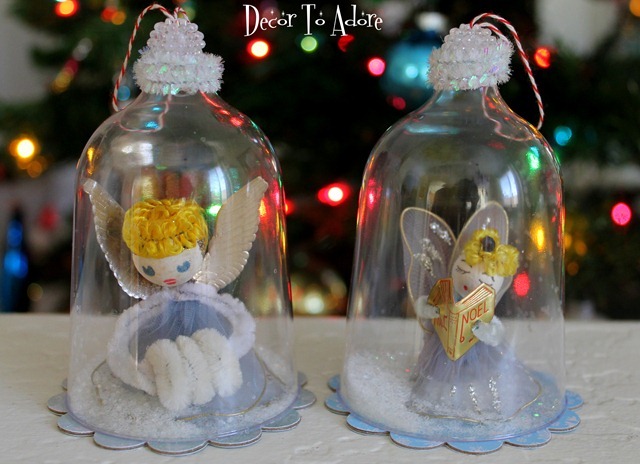
A few years ago I saw an ornament within the pages of Family Fun magazine. It was made out of a plastic drinking cup.

It’s par for the course that it generally takes me a year or more before I get around to making what inspires me. LOL.

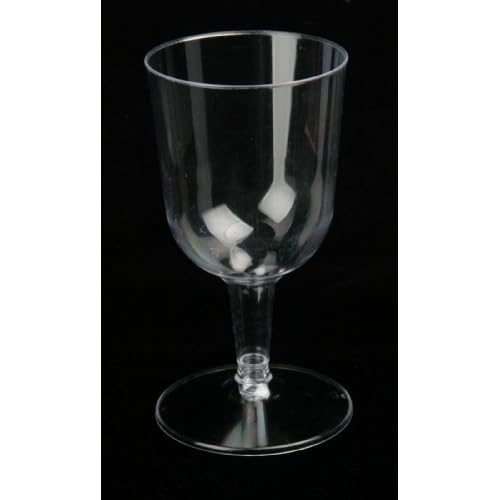
I found some plastic wine glasses at Wal Mart (6 for $1.99) which got my wheels turning. Mr. Décor helped me out by cutting off the stems with his band saw.

While Mr. Décor sawed away I took a round bead and strung some bakers twine through it and knotted the end. I then punched out 2 pieces of heavy weight scrapbook paper and 1 chipboard layer. Make sure your punch size is a bit larger than the circumference of the glass you use. The chipboard was sandwiched between the scrapbook punches, glued and weighted down while drying. It needs to dry completely flat or the cloche will not rest level. 

ceekay 009

Once the bottom layer is dry (approx. 2 hours) glue on your decorative elements and then paint on a thin layer of white craft glue to the bottom edge of the glass. Place the glass on top of the the scrap/chip board and then weigh it down to dry overnight.

Love the hillbilly method I used?

cloche 001-001

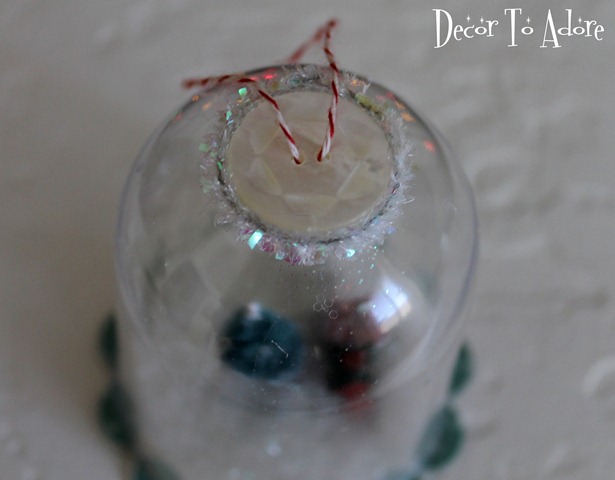
Once dry fill with glittery snow. Hot glue on your bead to seal.

ceekay 010

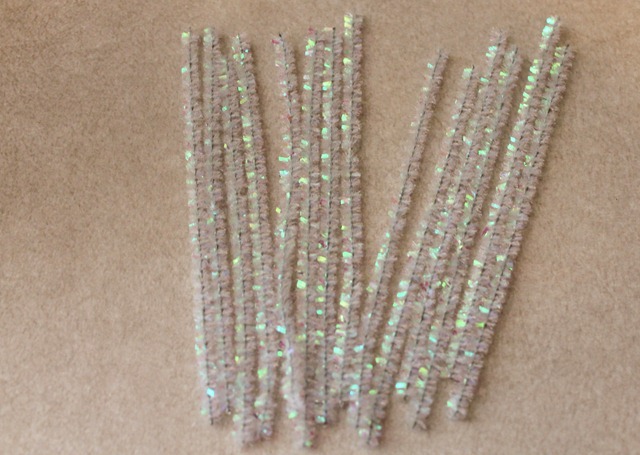
Cut 5” lengths of shimmery pipe cleaner (Michaels) with wire cutters to wrap around the bead base.  Hot glue in place.

cloche 004

An alternative to the bead closure is using a button. I love how this antique shell button has a scalloped motif that repeats the scalloped base.

cloche 036

These snowy treasures are time consuming, but so precious.  I created an ornament for each of my children. Sweet Boy wanted a train.

cloche 057

The Fashionista requested a deer. She graduates this Thursday and I wish our house was as peaceful as this wintery scene. :)

cloche 047

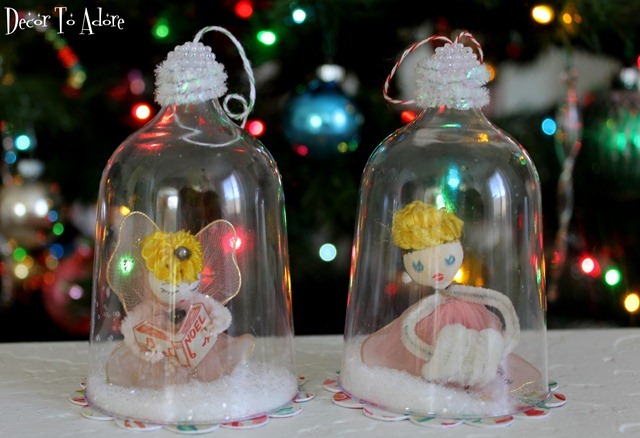
I have made two very special pink angel cloches. The angels are vintage gems from the 60’s.

These angelic ornaments are available in my Etsy shop.

100% of all the profits will be donated

to the charity Hope Unlimited for Children.

cloche 023

The motto of Hope Unlimited is “Saving One Child at a Time”.

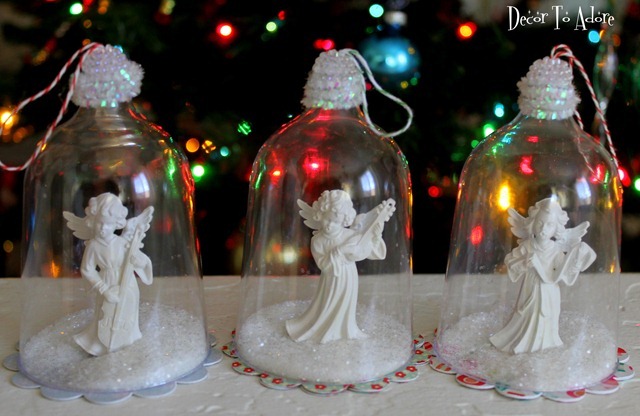
These aqua blue angels are being offered in the Etsy shop too with all profits benefiting this fine organization.

cloche 016-001

YOU personally can change the world of a child in mortal need. Not a child who is "just" living in poverty ... but a child whose very life is at grave risk unless circumstances change quickly. 

cloche 027-001

So yes, more angels. Vintage musical delights singing for HOPE.

cloche 005

If you’d like to purchase a Hope Angel please visit my Etsy shop.

If you would like to donate directly to Hope Unlimited please visit their site HERE.

You can make a difference in a child’s life.

Laura

Linking to:

Inspired By Charm PACOI, The Charm of Home, Common Ground, StoneGable, Today’s Creative Blog, Someday Crafts, SSS, Shabby Nest, Tatertots and Jello, Positively Splendid,The 36th Avenue, Jennifer Rizzo, Kelly’s Korner

© 2012 Decor To Adore Laura Ingalls Gunn All Rights Reserved

The 2012 Collection of Holiday Crafts and Decor

To contact us Click HERE

I love to welcome people to my home with a happy wreath. The Sparkle and Shine design for this year does just that.

mix 007

Right as you walk in the front entry there is a plate of sweets to greet guests.

tree 095-002

From there you can see the tree with a vintage inspired tree topper.

tree 126

On a table nearby sits holiday treasure boxes filled with candy.

boxes 071-001

I’ve already changed up the Christmas “fantle” and have added our stockings.

mantle 034

Yesterday I shared a very special tutorial ~ Cloches for Kids.

cloche 047

Today I am finishing up my baking and will share what goodies our family created and how they will be delivered later this week. I am also changing the Visions of Sugarplums table décor for a grand college graduation feast to be held tomorrow evening. Luckily my daughter’s soon to be alma mater, ASU, has colors of red and gold.

Photobucket

Mr. Decor and I are still enjoying the vintage inspired Advent Calendar for Sweethearts.

advent 035

Tomorrow’s post will bring this past weeks recap of adventures the elves had in spreading joy, love, peace and laughter throughout our household.

mantle 008

May the peace and love of the season be yours,

Laura

Linking to:

Nesting Place 2012 Holiday Tour of Homes

Parisian Party Hats for New Years Eve

To contact us Click HERE

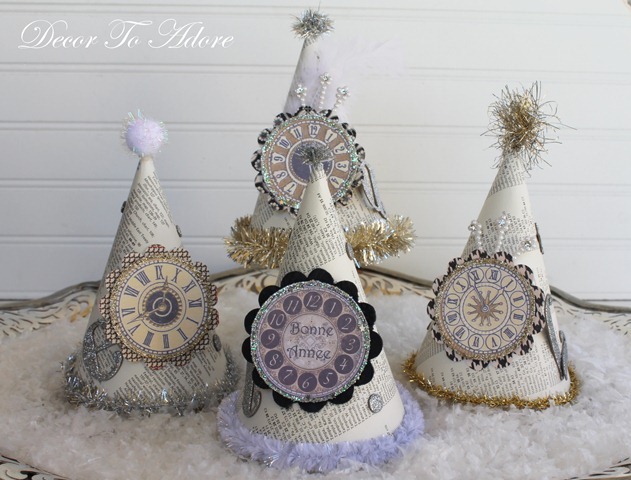
Back in early December I shared that I was planning a Parisian tablescape for New Year’s Eve.

parisian party hats 145

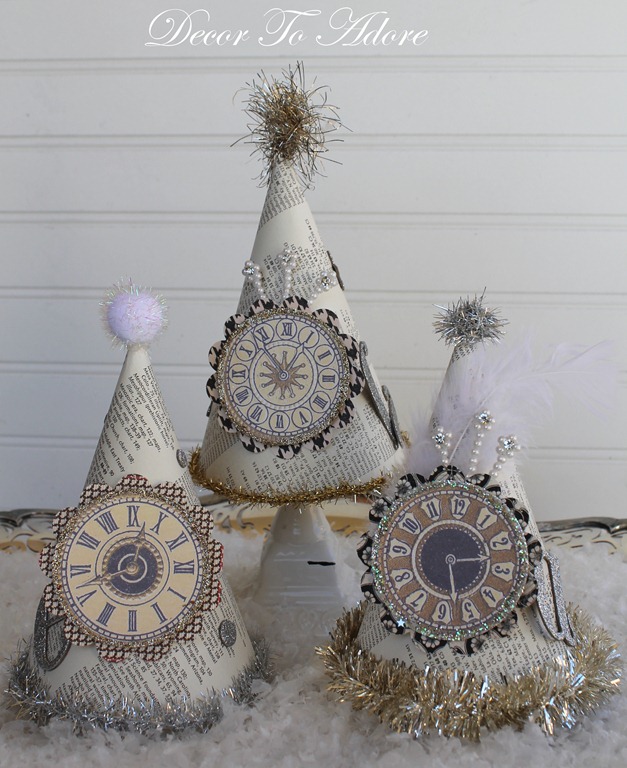
I thought it might be fun to give you a sneak peek and provide a tutorial for pretty party hats.

parisian party hats 127-001

To create the hat base I used a free template found at Jones Design Company. I had some old atlas pages that worked well. 

Time Saving TIP: Print the image directly onto heavy paper versus making a pattern, tracing and then cutting out the template. 

parisian party hats 070

After the hat was cut out various bits of leftover tinsel and trim were hot glued to the bottom. The two edges were then glued together to create a cone shape.

parisian party hats 081

Old clock face images were found on Google and The Graphics Fairy. White craft glue and glitter add a bit of sparkle.

parisian party hats 078

Scrapbooking paper punches in various sizes helped to create a rosette of sorts.

parisian party hats 138

Chipboard letters and feathers also add in some fun.

parisian party hats 096

Pearl picks propel the pizazz.

parisian party hats 098

Bits of tinsel or pom poms finish off the top tip.

parisian party hats 135-001

Happy.

parisian party hats 148

Happier.

parisian party hats 130-001

Go HERE to view the Parisian Party.

Laura

See you on Monday for Parisian Party Food!

bonne annee 049

Linking to:

 The Charm of Home, Common Ground, Today’s Creative Blog, Someday Crafts, Shabby Nest, Tatertots and Jello, Positively Splendid,The 36th Avenue, Jennifer Rizzo

Little Expense, Big Savings: What's Your Favorite Frugal Buy?

To contact us Click HERE
We purchased this toothpaste squeezer doohickey for $0.99 cents about four months ago: 


Since then, we're buying way less toothpaste. It should save us quite a few bucks in the long-term, too, provided we don't lose it / the cat doesn't eat it / it doesn't get sucked into the sweltering pit of despair we call "outside right now."

Which leads us to this softball question for a fiery Friday:

Sweet readers, what's your favorite frugal buy?

Do tell! Pass it on!

Stumble Upon Toolbar

A Beginner's Guide to Beans, Plus 42 Bean Recipes

To contact us Click HERE
This article first appeared in October 2009.
Some will balk at their flavor and size. Many will have texture issues. And still others just won’t enjoy the farting.

But know this: there are few cheaper, healthier, and more versatile foods than the humble bean. Members of the legume family, beans can be found everywhere from gourmet restaurants to campfire cauldrons. They’ve been vital to the survival of certain populations, and instrumental to the development of particular cuisines. Also, they taste good.

Still, there are folks out there unfamiliar with chickpeas and pintos, kidney and black beans. And for them, CHG proudly presents the following: a breakdown of why beans are wonderful, plus 42 tried-and-true recipes in which to use them.

HEALTH BENEFITS

Low in fat, high in protein, and astronomically high in fiber, beans work beautifully as the main components of recipes, but also as fabulous alternatives to meat. This is for a few reasons: A) they create a complete protein when paired with nuts, seeds, or grains, B) their chemical composition makes you feel sated longer than a lot of other foods, and C) they have a bulky and substantial mouthfeel, so you never feel deprived. Studies have found them to be solid tools in weight loss and maintenance, and integral to the prevention of all kinds of diseases.

If that ain’t enough for you, this WebMD blurb is pretty convincing: “In a recent study, bean eaters weighed, on average, 7 pounds less and had slimmer waists than their bean-avoiding counterparts -- yet they consumed 199 calories more per day if they were adults and an incredible 335 calories more if they were teenagers.” Sweet.

P.S. True to the well-known rhyme, beans make you both smartier and fartier. They contain both certain vitamins that improve brain function AND undigestable sugars, which lead to exciting intestinal activity, which leads to gas. So there you go.

PRICE

Grown globally from Ethiopia to Australia, beans are some of the most plentiful - and subsequently cheapest - edibles anywhere. A pound of dried beans in Brooklyn will generally run about $1, and will produce four to six cups of food after rehydration.

Compare that to meat. In my neighborhood, a pound of chicken breast (one of the healthier animal options) runs $1.69 on sale. It shrinks slightly when cooked, ultimately producing around two cups of poultry.

Let’s do some math, then. One cup of cheap chicken is $1.69 divided by two, or $0.85. One cup of beans is $1.00 divided by five, or $0.20. Using these (incredibly) rough numbers, chicken breast is 425% the price of dried beans.

Of course, the numbers will vary by area, sales, and math skills, but you get the idea.

DRIED OR CANNED?

It’s a controversy as old as storage itself: dried or canned beans? On one hand, dried beans are universally cheaper, and widely considered to possess a creamier consistency and better overall flavor. On the other hand, canned beans aren’t terribly expensive themselves, and the taste difference is pretty negligible when you’re talking about everyday kitchen use.

The tiebreaker, then, is time. If you have the wherewithal, forethought, and 90 to 480 minutes to rehydrate a bag of dried chickpeas, you’ll be rewarded in kind. If you‘re throwing dinner together and an hour-long prep time is crazy talk, canned beans are the way to go.

It’s worth noting that if respected cooks aren’t using canned beans already (Giada DeLaurentiis, Sara Moulton, etc.), they’re starting to come around. Even die-hard dried fans like Mark Bittman have been giving props to metal dwellers recently. Meaning: don’t fear the Goya.

INTRODUCING … THE BEANS

If you’ve ever tried chili, hummus, minestrone, Texas caviar, Mexican food, Indian food, Italian food, or, er, refried beans, you’ve already experienced the wonder of the bean. They’re omnipresent in cuisines all over the world, and come in a range of flavors and sizes that can be adapted to thousands of dishes. Here are six of the most common found in the U.S., along with a few recipe suggestions for each.

(A quick note before we get to the beans themselves: there are a zillion types of legume, and some [like the soybean] are rocketing in popularity stateside. But to keep things manageable, we’re sticking to a few big ones.)

Black Beans
Used frequently in Latin cuisines, the black bean is a small, ebony bean with an earthy flavor. I find it pairs very well with grains, and makes for a stellar soup.
Black Bean and Tomato Quinoa
Black Bean Brownies
Black Bean Burrito Bake
Black Bean Salad with Fresh Corn
Black Bean Soup
Calabacitas Burritos
Stuffed Peppers with Black Beans and Corn

Black-Eyed Peas
A terrible band, but a wonderful food, black-eyed peas are all over Southern cuisine. Like other beans, they’re great sources of fiber, folate, and protein. Unlike other beans, you will always feel like they’re looking at you.
Black-Eyed Pea (Texas) Caviar
Black-Eyed Pea Salad
Collard Greens and Black-Eyed Peas

Cannellini/White Beans
There are a ton of variations on the white bean, but I dig cannellinis in particular for their creaminess and flavor. Found in many Italian dishes, you’ll find that Microsoft Word often corrects its spelling to “cannelloni,” which is annoying.
Escarole and White Beans
Garlicky Long Beans and Beans
Grilled Zucchini with Quinoa Stuffing
Guacamole Bean Dip
Penne with Lemon, Potatoes, and Cannellini
White Bean and Tarragon Soup
White Chicken Chili
Spinach and Cannellini Bean Dip

Chickpeas (Garbanzo Beans)
Without chickpeas, there would be no hummus. And without hummus, there would be no joy. Vital to Italian, Indian, and Middle Eastern cuisines (among others), the plentiful and versatile garbanzo bean can be found in virtually every form, from dip to stew to flour (though I have yet to see a chickpea smoothie). Due to its subtle flavor and increasing ubiquity in the U.S., I like to think of the chickpea as a gateway bean; if you like it, odds are other legumes will soon follow.
Beets and Greens Curry with Chickpeas
Chickpea Salad
Couscous with Chickpeas, Tomatoes, and Edamame
Curry in a Hurry
Greek-Style Chickpea Salad
Lemony Light Hummus
North African-style Chickpea Salad
Pasta e Ceci
Pasta with Zucchini and Chickpeas
Pasta with Broccoli and Chickpeas
Pindi Chana (Spicy Chickpea Curry)
Roasted Chickpeas
Shredded Zucchini and Chickpeas Over Polenta

Kidney Beans (red and pink)
Substantive and quite large in comparison to other common legumes, kidney beans go great on salads and substitute fabulously for meat in chilis and stews. And seriously, what’s a frugal kitchen without red beans and rice?
Chili Corn Pone Pie
Pumpkin Turkey Chili

Pinto Beans (Frijoles)
Wonderful on their own and even better mashed, these pink-brown legumes claim the great honor of being the only bean my mom likes. Also, I could be talking out my neck here, but I find pintos a little sweeter than black beans and chickpeas.
Refried Beans
Swiss Chard with Pinto Beans and Goat Cheese

Multiple Beans
Each of the following recipes use more than one type of bean.
Bodega Beans (any)
Camp Stove Veggie Chili (black, kidney)
Curried Chickpeas and Black Beans (chickpeas, black)
Easy Vegetarian Bean Chili (any)
Gallo Pinto (pinto, black)
Indonesian Curried Bean Stew (chickpeas, black, kidney )
Light Leftover Turkey Chili (black, kidney)
Turkey Chili with Beans (white, pink, kidney)

And that's our ballgame. Readers, how about you? What are your favorite bean recipes?

~~~

If you like this article, you might also dig:
  • 20 Cheap, Healthy Dishes Made From 10 Pantry Staples
  • How to Tell if a Recipe is Cheap and Healthy Just By Looking at it
  • Spend Less, Eat Healthier: The Five Most Important Things You Can Do

Stumble Upon Toolbar